
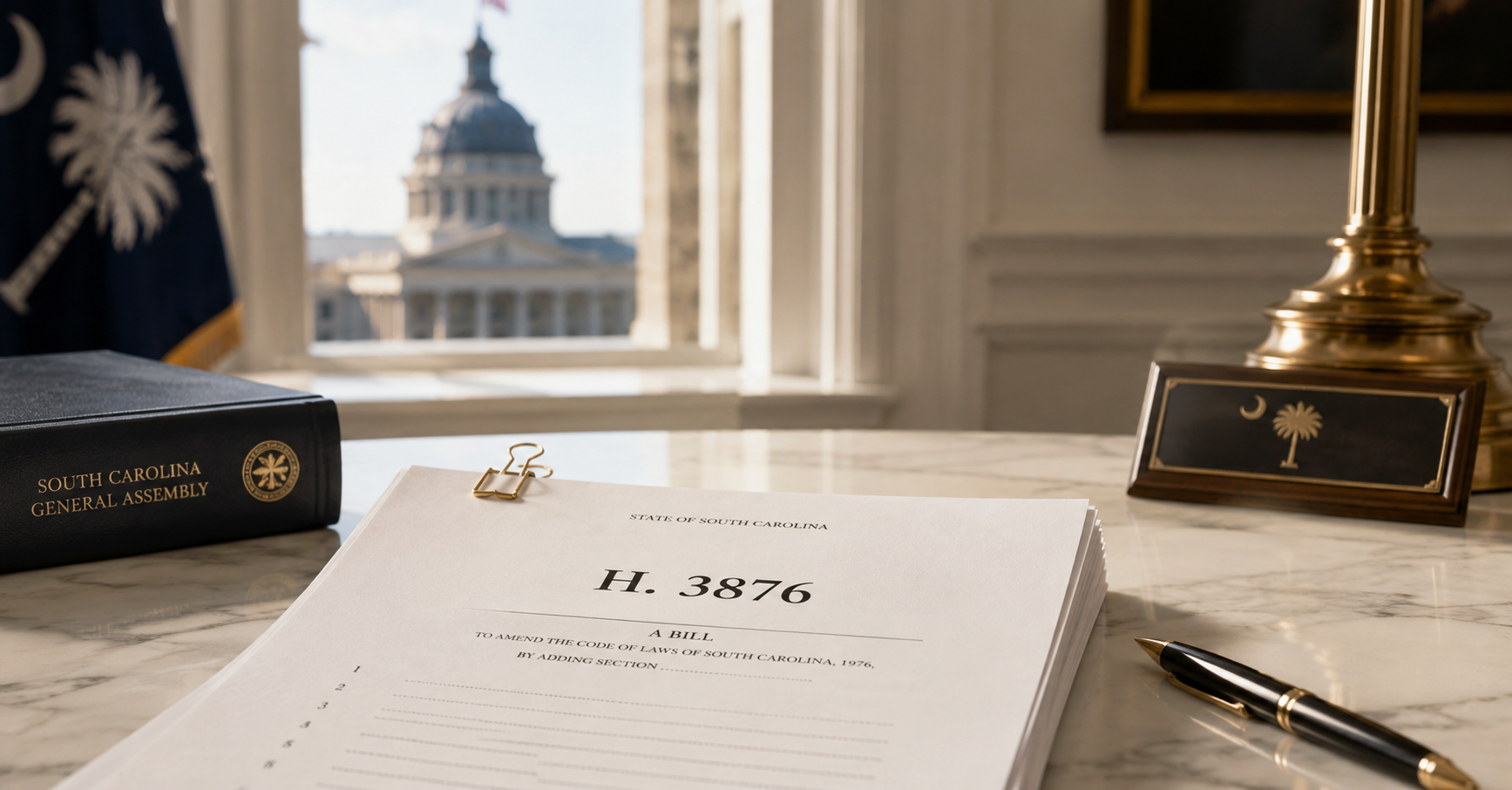
Some bills announce their impact loudly.
Others hide it in definitions.
H. 3876 falls into the second category.
At first glance, the bill reads like a routine accommodations-tax measure. It deals with intermediaries, providers, professional property management companies, local accommodations taxes, merchant-of-record designations, remittance obligations, reporting duties, and municipal notification requirements. In legislative language, it is a bill about tax administration.
But in practical terms, H. 3876 could reach much further.
This bill is not merely about whether accommodations taxes are paid. Those taxes already exist. The real policy question is whether the General Assembly should restructure who controls the short-term rental transaction, who carries the compliance burden, and who assumes liability when the booking is made through an online platform.
That is not a small question.
It is a market-design question.
And South Carolina should be careful before using statute to redesign a private marketplace that is already generating tourism activity, tax revenue, and consumer choice.
The Merchant-of-Record Issue Is the Core of the Bill
The key phrase in this debate is merchant of record.
That may sound like technical language, but it is the heart of the matter. The merchant of record is the party responsible for processing the transaction and handling tax collection and remittance obligations. Under H. 3876, the bill creates a framework for determining whether an accommodations intermediary, accommodations provider, or professional property management company is responsible for collecting and remitting taxes and fees imposed on accommodations. The official bill summary states that H. 3876 adds Section 12-36-72 to specify the party responsible for collecting and remitting certain taxes and fees on accommodations.
That matters because short-term rental platforms are not simply advertising boards. They are integrated transaction systems.
The platform handles the booking.
The platform processes payment.
The platform often calculates and collects taxes.
The platform remits those taxes to the proper authority.
When legislation changes that chain of responsibility, it does more than clarify tax law. It can alter how the marketplace functions.
A Bill Does Not Have to Raise the Rate to Raise the Cost
Supporters may argue that H. 3876 is not a tax increase.
That may be technically true.
But policy professionals know that compliance costs are economic costs. If a statute creates additional reporting burdens, liability exposure, payment-processing complications, platform coordination requirements, or professional-management obligations, the cost of doing business rises.
Those costs do not disappear.
They migrate.
They may migrate into management fees.
They may migrate into service fees.
They may migrate into nightly rates.
They may migrate into fewer available listings.
For the consumer, the result can be the same: a more expensive vacation rental market.
For the small operator, the result can be more paperwork, more risk, and less room to compete.
That is why this bill deserves more scrutiny than a normal tax-compliance bill. It may not change the statutory rate, but it could change the cost structure of the short-term rental market.
The Existing System Is Already Producing Revenue
The argument for legislative intervention would be stronger if the current system were failing to generate tax revenue.
But that is not the case.
Airbnb has reported that travel on its platform generated more than $2.1 billion in economic activity across South Carolina in 2025, supported 30,000 jobs, and generated more than $565 million in total tax revenue. Local reporting has also stated that Airbnb collected and remitted $89.7 million in South Carolina state and local taxes in 2025.
Reasonable people can debate the exact structure of tax reporting and local accountability. That is a legitimate legislative function.
But the existence of tax revenue at this scale should cause lawmakers to ask a more disciplined policy question:
What specific problem is H. 3876 solving, and is the cure more disruptive than the disease?
If the concern is documentation, improve documentation.
If the concern is audit access, create better audit records.
If the concern is local tax visibility, build a clearer reporting process.
But lawmakers should be cautious about changing the payment and merchant-of-record architecture of an industry that is already producing substantial revenue.
Innovation Often Looks Messy to Government
The short-term rental economy does not fit neatly into older accommodations models.
That is the point.
Innovation rarely fits the forms government already has on file.
Uber disrupted transportation.
Netflix disrupted video rental and entertainment distribution.
Airbnb disrupted lodging.
In each case, government had to decide whether to regulate toward the future or protect the past. The best regulatory approach is not no regulation. The best approach is smart regulation that protects consumers, preserves tax compliance, and avoids crushing the innovation that created the market in the first place.
H. 3876 risks going beyond tax clarity and into market interference.
That should concern policymakers who care about tourism, entrepreneurship, property rights, and South Carolina’s reputation as a business-friendly state.
Small Operators Could Feel the Pressure First
Large operators can absorb complexity.
They have legal counsel, compliance staff, accounting systems, and administrative capacity.
Small property owners and small property managers do not always have that luxury.
If H. 3876 creates uncertainty about who must collect, remit, document, and report taxes in platform-based transactions, small operators may face the hardest choices. Some may raise prices. Some may avoid professional management. Some may stop listing on certain platforms. Some may exit the market entirely.
That is not a theoretical concern. Outside policy analysis has warned that H. 3876 could distort the short-term rental market in favor of larger providers that are better able to absorb added costs.
A bill written in the language of administrative clarity could have the practical effect of consolidating market power.
That is worth pausing over.
The Senate Should Slow Down
H. 3876 may be well-intentioned. Tax compliance matters. Local governments need reliable revenue. Property owners deserve clear records. The Department of Revenue should not be forced to administer a fragmented system without accurate data.
But good intentions do not guarantee good policy.
The Senate should ask whether this bill creates clarity or confusion.
Whether it protects taxpayers or shifts costs.
Whether it modernizes tax administration or penalizes platform innovation.
Whether it helps small operators or advantages larger ones.
South Carolina does not need to weaken a growing tourism sector to solve a reporting problem. It needs a narrower, smarter solution.
For those following this legislation, now is the time to contact your State Senator, ask specific questions, and request a no vote on H. 3876 unless the bill is substantially narrowed to avoid disrupting the short-term rental marketplace.
Legislation should solve problems.
It should not create new ones.