Political campaigns often feature familiar promises: greater transparency, stronger accountability, responsible spending, and better stewardship of taxpayer dollars.
Democratic candidate Bruce K. Cole talks about all of those things in his campaign for South Carolina Comptroller General. But beneath those familiar themes lies a broader governing philosophy that may be one of the more interesting ideas emerging in this year’s statewide elections.
Cole calls it “Civic Wealth.”
At first glance, the phrase sounds like an economic development strategy. In practice, however, it is a framework for evaluating government itself.
The core premise is straightforward: government should not be judged solely by how much money it spends or even how efficiently it spends it. Government should be judged by the value it creates for the people it serves.
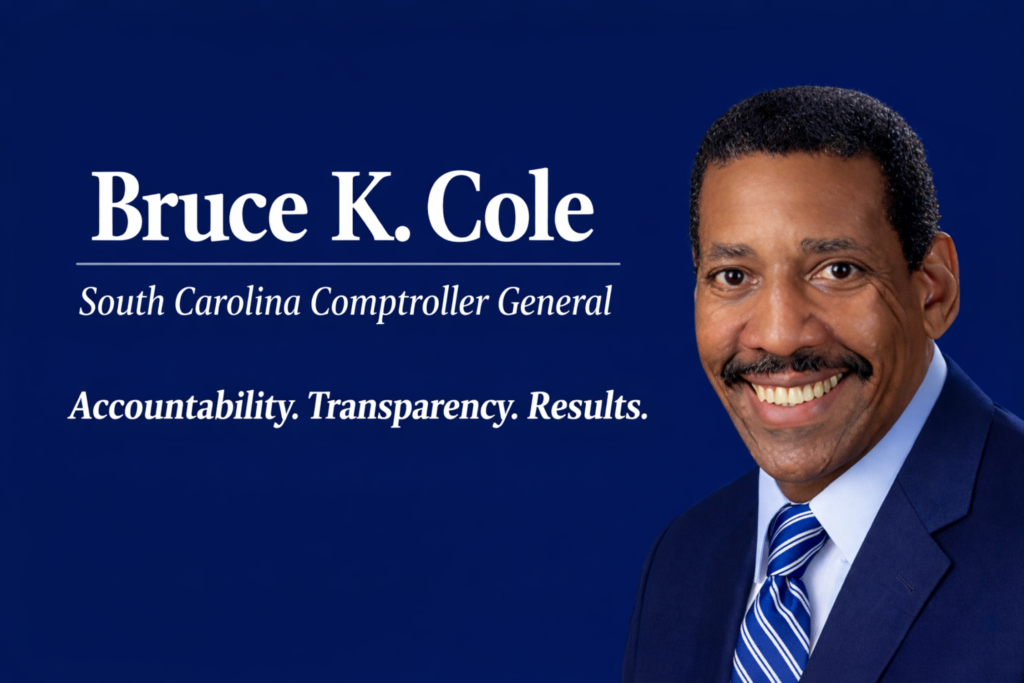
For Cole, civic wealth extends beyond financial measures. It includes stronger communities, greater public trust, expanded opportunity, improved government performance, and measurable outcomes that improve the quality of life for South Carolinians.
In many ways, the concept represents an attempt to move beyond traditional debates over the size of government.
Cole frequently summarizes his philosophy in a simple phrase:
“Not bigger. Not smaller. Better government.”
That distinction is important.
For decades, political debates have often focused on whether government should grow or shrink. Cole’s argument is that neither question gets to the heart of the matter. The more important question, he suggests, is whether government is producing value.
That perspective has significant implications for the Office of Comptroller General.
Traditionally viewed as the state’s chief accounting office, the Comptroller General is responsible for maintaining South Carolina’s financial records, overseeing accounting systems, and helping safeguard taxpayer funds. While the office has long been associated with financial reporting and fiscal oversight, Cole envisions a more active role in promoting accountability and performance.
Under his approach, government would not simply track expenditures. It would measure outcomes.
Taxpayers would have greater access to financial information. Public performance dashboards would help citizens evaluate agency effectiveness. Budget decisions could be tied more closely to measurable results. Programs would increasingly be evaluated based on what they deliver rather than simply what they cost.
The goal is not merely transparency for transparency’s sake.
Cole argues that accountability only has meaning when citizens can understand what government is doing and whether it is working.
That emphasis on outcomes reflects both his professional background and academic training.
A certified public accountant, Cole has spent his career managing complex financial systems, leading organizational restructuring efforts, and improving operational performance. He has managed more than $1 billion in assets, overseen significant cost-saving initiatives, and worked across both public and private sector institutions.
His educational background includes degrees from Harvard University, Northeastern University, Stanford University, and Clemson University.
Yet perhaps the most notable aspect of his campaign is not his résumé but the attempt to introduce a broader conversation about public value.
In an era of declining trust in institutions and increasing demands for accountability, Cole’s Civic Wealth framework asks a fundamental question:
What should taxpayers expect in return for their investment in government?
His answer is that they should expect more than balanced books.
They should expect stronger communities.
They should expect measurable results.
They should expect transparent leadership.
And they should expect government to create civic wealth.
Whether that idea gains traction with voters remains to be seen. But as South Carolina Democrats prepare to choose their nominee for Comptroller General, Bruce Cole is offering something more than a management plan.
He is offering a governing philosophy—one that seeks to redefine success not by what government spends, but by what government produces for the people it serves.
Vote Tuesday, June 9, 2026. Learn more about Bruce Cole’s campaign for South Carolina Comptroller General at ColeForSC.com.