
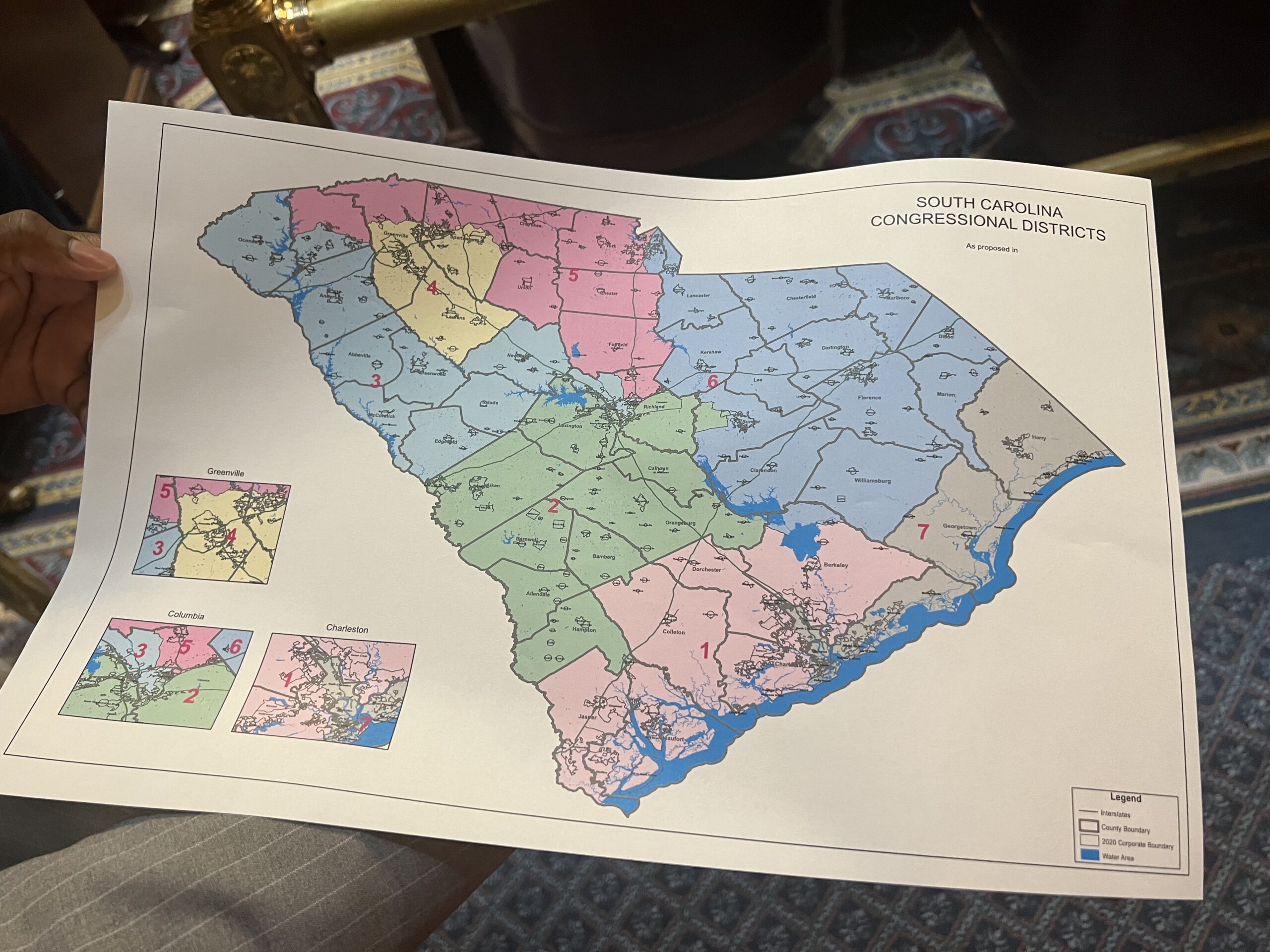
While South Carolina’s redistricting debate has focused largely on congressional control, racial representation, and the future of U.S. Rep. Jim Clyburn’s district, another issue is moving quietly beneath the surface: whether the state can redraw political power this close to an election without confusing voters, burdening election officials, and disrupting the basic mechanics of democracy.
That issue may become just as important as the map itself.
South Carolina Republicans are pushing a mid-decade congressional redistricting plan that could reshape the state’s current 6 Republican / 1 Democratic U.S. House delegation into a possible 7 Republican seat map. The proposal targets the state’s lone Democratic-held congressional district, currently represented by Clyburn, a longtime Black Democratic leader. Republican supporters have argued that the map reflects partisan opportunity after a recent U.S. Supreme Court ruling, while Democrats and civil rights groups have criticized the effort as a rushed attempt to weaken Black and Democratic voting power. (Democracy Docket)
But the question now is not only where the lines will be drawn.
It is also when voters will be expected to understand them.
The timing is tight. South Carolina’s regular primary calendar was already moving forward when lawmakers began considering changes to congressional districts. The official bill page for H. 5683 shows the legislation was introduced in May and later amended in the House, with the bill listed as “amended — not printed” as of May 15. (South Carolina Legislature Online)
That matters because redistricting is not just a legislative act. It is an election-administration process.
Once district lines change, almost everything connected to an election may have to be adjusted: candidate filing, ballot design, precinct assignment, voter education, absentee materials, sample ballots, voting machine programming, poll worker guidance, and public notices.
That is the part of redistricting most voters never see.
The map gets the headline. The machinery gets the burden.
According to reporting from Bloomberg Law, South Carolina Republican lawmakers face two major obstacles in the special session: a tight election calendar and continued divisions inside their own party. The report also noted concerns about changing election lines close to the primary, including possible complications for military and overseas ballots. (Bloomberg Law)
That concern moves the redistricting debate out of the realm of pure politics and into a practical question: How much change can an election system absorb before voters start losing confidence?
South Carolina is not new to redistricting fights. Every state redraws political lines after the Census. But this effort is different because it comes in the middle of the decade, after elections have already been organized around existing districts, and after some candidates, campaigns, county parties, and voters have begun planning around the current map.
Supporters of the redistricting push see the moment differently. The South Carolina Republican Party and national Republican allies have framed the issue as an opportunity to maximize Republican representation after the Supreme Court ruling opened the door for new map challenges and revisions. Some Republicans argue the current Sixth District was drawn too heavily around race and that a new map can be defended as a partisan redraw rather than a racial one. (Reuters)
Still, not all Republicans are unified.
Earlier this week, five South Carolina Senate Republicans joined Democrats in blocking a procedural move that would have allowed the redistricting effort to continue through the regular session. Reuters reported that the effort failed because it did not receive the two-thirds vote needed to extend the session. (Reuters)
Some of that resistance appears to be strategic rather than ideological. Reports indicate that several Republican senators raised concerns that an aggressive 7-0 Republican map could backfire politically or legally, potentially making surrounding districts more competitive for Democrats. (New York Post)
That internal disagreement is important. It shows this is not simply a clean partisan fight between Republicans and Democrats. It is also a debate among Republicans over risk, timing, legal exposure, and whether trying to capture every seat could weaken the party’s position instead of strengthening it.
For voters, however, the internal strategy debate may be less important than the downstream effect.
If the map changes, voters will need to know whether they are still in the same congressional district, whether their primary date has changed, who their candidates are, and whether their ballot will look different. In communities that already face lower voter-information access, those questions can become barriers.
That is where this story becomes larger than Columbia.
A voter in Orangeburg, Richland, Charleston, York, Spartanburg, or any county affected by new lines may not follow every State House motion. But that voter will feel the impact if they receive conflicting information, miss a changed deadline, or show up unsure of who is on their ballot.
Democrats and voting rights groups argue that this kind of confusion is not a side effect but part of the danger. The ACLU of South Carolina has described the proposal as a mid-decade partisan gerrymander and argued that voters should choose elected officials, not the other way around. (ACLU of South Carolina)
Republicans backing the effort would likely counter that redistricting is a lawful legislative power and that the state has an interest in adopting maps that comply with recent court decisions and reflect permissible partisan considerations.
Both arguments are now running into the same calendar.
The overlooked issue is not whether South Carolina has the legal ability to redraw districts. The question is whether doing so this late creates a democratic strain that voters, counties, and election officials are forced to carry.
That strain is difficult to measure in a court filing or a vote count. It shows up in quieter ways: fewer informed voters, more calls to county election offices, more confusion about ballots, more pressure on poll workers, and more distrust from citizens who already believe the political process is designed without them in mind.
Redistricting is often described as a fight over lines.
In South Carolina, it is becoming a fight over time.
And time may be the most important line lawmakers are drawing.
This is a developing story. This article will be updated as H. 5683 moves through the legislative process and as additional details become available about the proposed map, election calendar, and local voter impact.